NVIDIA/SkillEvaluator — a trending Python project
Multi-tier framework for evaluating AI agent skills with quality gates, semantic overlap detection, synthetic evaluation dataset generation, and live agent evaluation that measures how skills affect agent behavior.
NVIDIA/SkillEvaluator — Python · 1,317 stars · 155 forks · +133 today
Multi-tier framework for evaluating AI agent skills with quality gates, semantic overlap detection, synthetic evaluation dataset generation, and live agent evaluation that measures how skills affect agent behavior.
SkillEvaluator
#






📺 Livestream: Ask the Experts: Evaluating Agent Skills
SkillEvaluator checks AI agent skills and measures their effect on task results: start with quality checks, then compare runs with and without a skill.
Agent skills are folders of instructions and supporting files defined by the Agent Skills specification. SkillEvaluator is part of the NVIDIA Verified Skills pipeline.
Get started
#Three ways in, one CLI, same results.
| 1. Run the CLI directly | 2. Add it to your repo via CI | 3. Wire it to your agent |
|---|---|---|
Install (or Run all Tier 1 checks, no API key: Or run from a clone: Quickstart. |
Check changed skills on every pull request. On GitHub, run: It opens a setup PR. On GitLab, copy the CI template. |
Add the SkillEvaluator skill to Claude Code, Codex or any skill-aware agent: Then ask: "Is my skill any good?" No Node.js? Copy the folder. |
Guides: installation, CI setup (GitHub, GitLab, report examples) and agent skill.
Quickstart
#Both paths use bundled text-analyzer.
| Start here | Requires | First result |
|---|---|---|
| Run without an LLM | Git and uv | A deterministic quality score and findings |
| Use NVIDIA Build | Git, uv, and a Build API key | Model-backed rubric scores and feedback |
Install uv and Git, then get the example:
git clone --depth 1 https://github.com/NVIDIA/SkillEvaluator.git
cd SkillEvaluator
uv provisions Python 3.13 and dependencies. For standalone installation, see Installation.
Run without an LLM
#uv run --python 3.13 skillevaluator quality-check \
src/skillevaluator/tier3/reference_skills/text-analyzer \
-r cli -r json -o reports/first-quality
No API key, scanner, GPU or Docker is needed. The example scores 86.2/100 (B),
exits 0 and saves reports/first-quality/skillevaluator-quality.json. The
passing threshold defaults to 70.
This checks static quality; publication evidence stays INCOMPLETE. Security
needs scanners; agent impact needs live evaluation. Replace the example path
with your skill directory. See the
keyless walkthrough.
Use NVIDIA Build
#Eligible NVIDIA Developer Program members can use NVIDIA-hosted endpoints for free prototyping, subject to access terms and rate limits.
- Sign in at build.nvidia.com and complete enrollment.
- Open a model page, select Get API Key, and generate your key.
- Set the provider and key in the same terminal, then run the rubric check:
export SKILL_EVAL_LLM_PROVIDER=nv_build
export NVIDIA_API_KEY='nvapi-...'
uv run --python 3.13 --extra llm skillevaluator rubric-eval \
  src/skillevaluator/tier3/reference_skills/text-analyzer \
  -r cli -r json -o reports/first-build
The command sends skill documentation to the model and saves feedback in
reports/first-build/skillevaluator-rubric.json. No agent runtime or Docker is
needed. Completed evaluations can still fail rubric thresholds.
The same key supports Tier 2 embeddings and supported Tier 3 agents. See the Build walkthrough or provider configuration.
Three-tier overview
#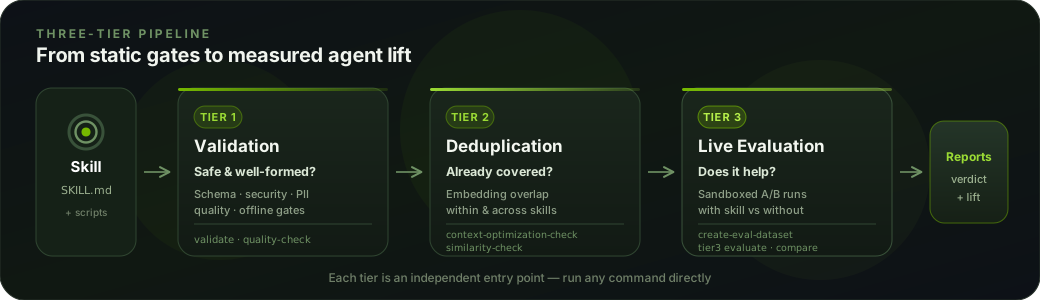
Each tier is independent. Add its extra to your command:
| Tier | Question | Example after setup | Additional setup |
|---|---|---|---|
| Tier 1: Validation | Is the skill safe, well-formed and harness-compatible? | uv run skillevaluator tier1 ./my-skill --no-llm |
External scanners for full static coverage; a provider and model clients enable LLM checks |
| Tier 2: Deduplication | Does guidance repeat or overlap? | uv run --extra tier2 skillevaluator tier2 ./my-skill |
Embeddings and chat; add --catalog ./skill-catalog.json for inter-skill comparison |
| Tier 3: Live Evaluation | Does the skill help the agent? | uv run --extra tier3 skillevaluator tier3 ./my-skill |
Provider access, a supported agent, and a running sandbox (Docker by default) |
Tier 1 fetches pinned, verified SkillSpector and Gitleaks releases when they
are missing; Semgrep is optional. See scanners.
--no-llm does not remove scanner requirements; a scanner that cannot run is
INCOMPLETE and exits nonzero.
SkillSpector provides specialized skill
security scanning; Harbor, the
open-source agent evaluation framework, powers sandboxed agent runs.
Tier 2 reports when inter-skill comparison did not run. Tier 3 autopilot reuses sources or creates one skill-grounded case with limited coverage. See tier guides.
Run the combined pipeline
#After setting up the provider, scanners, and agent sandbox, run all three tiers:
uv run --python 3.13 --extra all skillevaluator doctor --env-mode docker
uv run --python 3.13 --extra all skillevaluator validate ./my-skill
doctor checks readiness, not inference success. validate runs all tiers with
autopilot for skills. Use --tiers 1,2 to skip live evaluation or --tiers 1 for
static checks. --no-autopilot requires an existing source. Other artifact types
retain their applicable stages.
Tier 1 gates validate. Tier 2 gates unless --no-block-on-dedup is set;
Tier 3 gates only with --block-on-agent-eval. Model and managed-sandbox usage
can incur charges; see runtime and cost.
Standalone generation needs substantive evals/EVAL.md guidance, a --prompt
file with task requests and outcomes, or matching retained traces. --force
below replaces the autopilot starter; --refine refines it. Explicit
--grounding skill permits skill-only starters. Review cases; templates omit
unauthored negatives.
uv run --python 3.13 --extra tier3 skillevaluator tier3 create-eval-dataset ./my-skill --full --prompt eval-guidance.md --force
Run from a source checkout
#Use uv run --python 3.13 with the relevant extra. See
Installation for extras and standalone upgrades.
Research and citation
#Resources: paper, PDF, DOI, BibTeX, and the NVIDIA Developer blog. Cite the paper and record the SkillEvaluator release or commit; see CITATION.cff.
Documentation
#See the documentation for setup, tier guides, reports, CI integration, CLI reference, and performance dashboard.
Installation and third-party software
#Follow the installation guide to choose the full installation or a smaller per-tier setup.
This project will download and install additional third-party open source software projects. Review the license terms of these open source projects before use.
Contributing
#Read CONTRIBUTING.md and run:
make lint && make test && make build
See project governance and the Code of Conduct.
Support
#Support level: Experimental. Community-supported, best-effort, with no SLA or NVIDIA enterprise support entitlement. Report bugs and feature requests through GitHub Issues; see SUPPORT.md.
Security
#Report suspected vulnerabilities using the private process in SECURITY.md. Do not disclose security issues in a public GitHub issue.
Releases
#Release changes are recorded in CHANGELOG.md and GitHub Releases.
License
#Apache License 2.0 — see LICENSE, NOTICE, and THIRD_PARTY_NOTICES.md.
Copyright (c) 2026 NVIDIA CORPORATION & AFFILIATES. All rights reserved.
Content above is the README of NVIDIA/SkillEvaluator, reproduced from GitHub’s trending list. All rights remain with the original authors.
Newsletter
New posts in your inbox. Confirm by email, unsubscribe any time.
More in Python
View allelementalsouls/Claude-BugHunter — a trending Python project
A Claude Code skill bundle for bug hunting and external red-team work - 82 skills, 15 slash commands, 681 disclosed-report patterns curated across 24 core vulnerability classes, plus enterprise identity + infrastructure attack matrices.
via GitHub · 10 min
tradermonty/claude-trading-skills — a trending Python project
Claude Code skills for equity investors and traders — market analysis, technical charting, economic calendars, screeners, and trading strategy development.
via GitHub · 22 min
homeassistant-ai/ha-mcp — a trending Python project
Configure and automate Home Assistant with Claude, ChatGPT, and other AI assistants.
via GitHub · 11 min
ZhuLinsen/daily_stock_analysis — a trending Python project
LLM 驱动的多市场股票智能分析系统:多源行情、实时新闻、决策看板与自动推送,支持零成本定时运行。 LLM-powered multi-market stock analysis system with multi-source market data, real-time news, decision dashboard, automated notifications, and cost-free scheduled runs.
via GitHub · 2 min

Comments
Posting as a guest